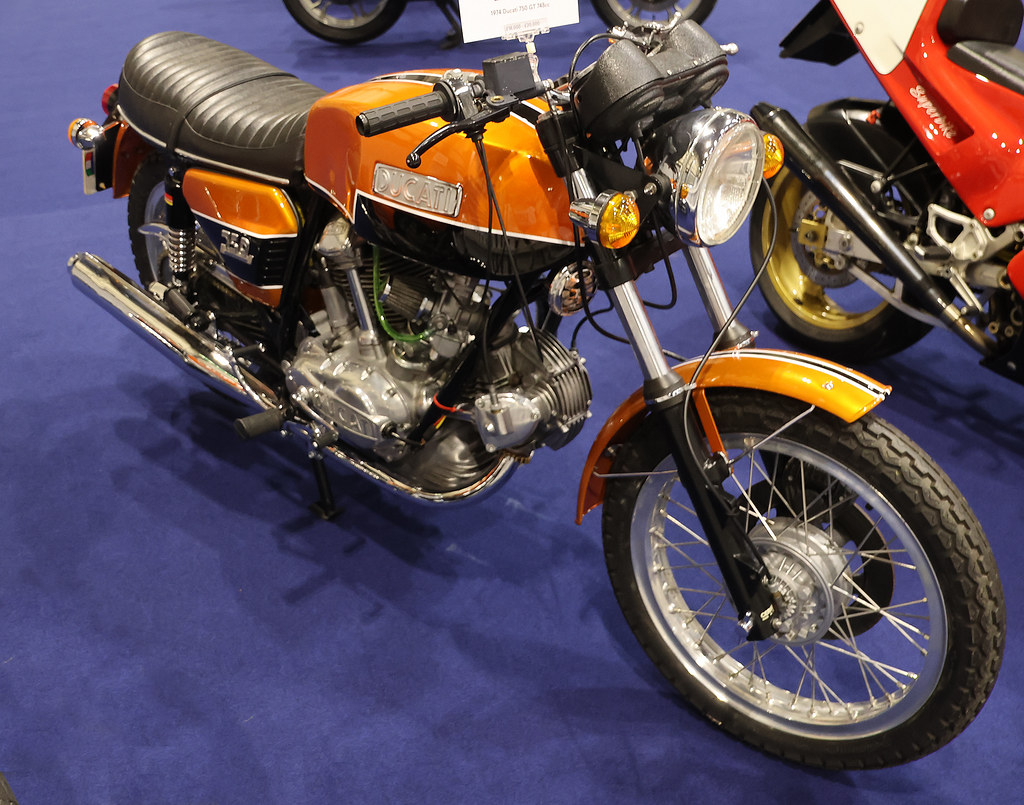
750 GT
The touring 750: the first of the line, upright and long-legged.
Between 4,093 and 4,133 750 GTs were built.
In 1971 a pre-production run of 82 of a proposed 100 750 GTs was built, starting July 1971.
Regular production began in 1972, with 519 motorcycles built for that model year.
About 40 more 750 GTs were built from spare parts in 1978, for the Australian importer.
750 GT sales in Australia were 33 in 1971, 151 in 1972, 202 in 1973 and 396 in 1974.
- Engine
- 748 cc air-cooled 90° V-twin
- Bore × stroke
- 80 × 74.4 mm
- Compression
- 8.5 : 1
- Power
- 50 to 65 hp
- Dry weight
- 185 to 193 kg
- Top speed
- 190 to 200 km/h
- Tank
- 17 to 20 l
- Built
- 4,093 to 4,133
Engine and carburettors
- The 750 GT was the first Ducati with a 90-degree V-twin engine.
- The 750 GT uses conventional coil valve springs, not desmodromic valve gear.
- Early production 750 GTs used Spanish-made Amal 30 mm carburettors.
- 30 mm Dell'Orto carburettors replaced the Amals in 1972 or 1973.
- It reportedly took eight hours to assemble each production engine.
Frame, brakes and wheels
- The 750 GT frame is an open cradle that uses the engine as a stressed member, made from seamless chrome-molybdenum tubing.
- Early 750 GTs had a single 280 mm front disc with a twin-piston Lockheed caliper and a 200 mm rear drum.
- During 1973 Italian Scarab or Brembo brakes replaced the British Lockheed.
- The 750 GT had a 38 mm leading-axle Marzocchi fork, replaced for 1974 by a centre-axle Ceriani or Marzocchi fork.
- The 750 GT had Borrani alloy rims, 19 inch front and 18 inch rear, later replaced by steel rims.
- The 750 GT wheelbase is given as 1,500 to 1,562 mm.
Colours and finish
- The first 750 GTs had silver-painted frames; later bikes had black frames (Motorrad Classic: silver up to engine number 500, black from 501).
- Early 750 GTs came with metallic tank and side-cover colours such as gold, lime green, bright blue or red.
- Early 750 GTs had fibreglass tanks and stainless mudguards; steel tanks and painted steel mudguards followed, the tank in 1973 for US safety rules.
- UK law required a steel tank on the 750 GT, while a fibreglass tank was used elsewhere, including Australia.
- Early 750 GTs had Smiths instruments, replaced by Veglia in 1973.
- Early 750 GTs had Conti exhausts, later replaced by Lafranconi silencers for noise rules.
Versions and markets
- The US version of the 750 GT had higher handlebars and a larger taillight.
Tell them apart
| 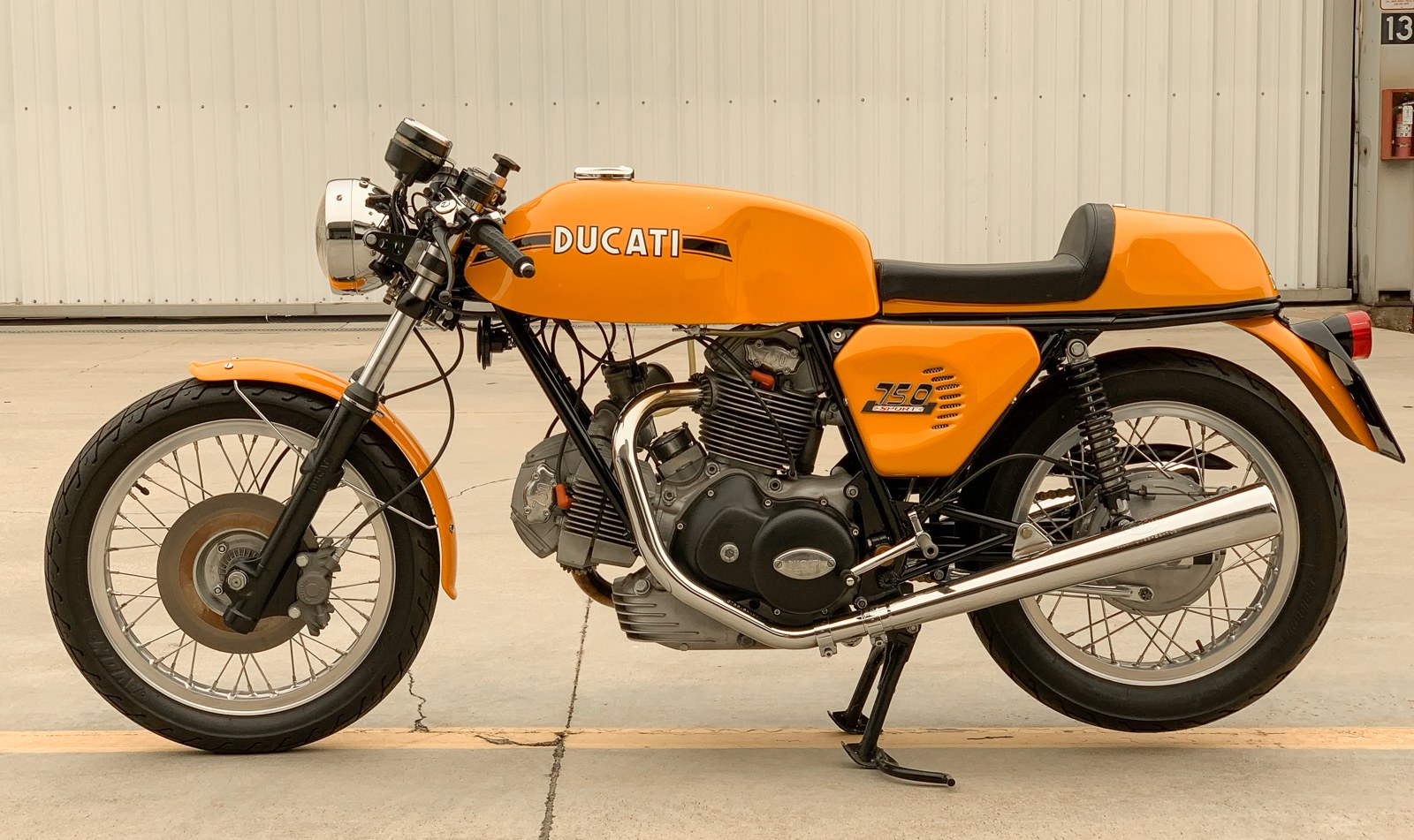 | 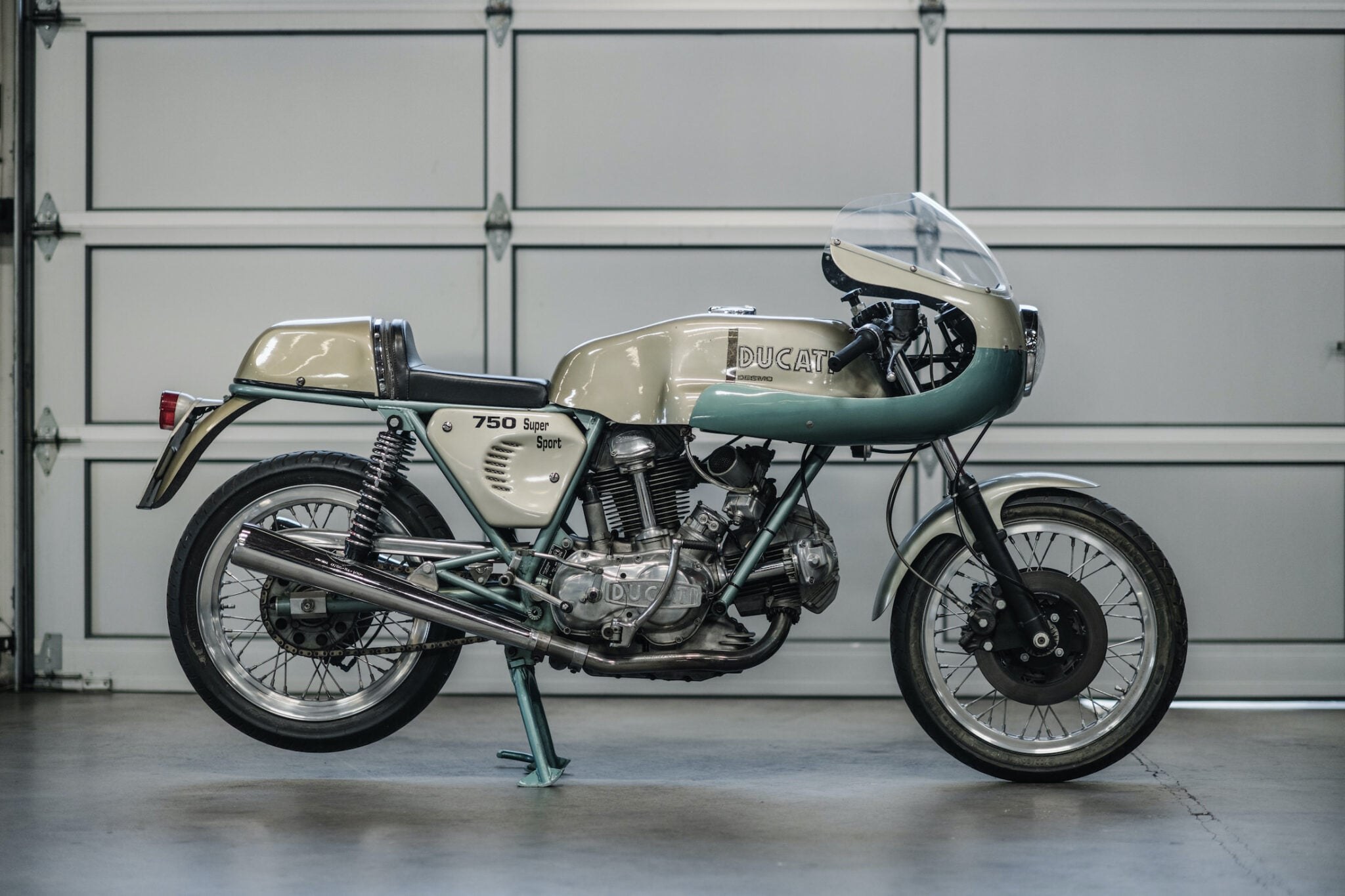 | |
|---|---|---|---|
| Valves | Coil springs | Coil springs | Desmodromic |
| Carburettors | 30 mm Amal, later Dell'Orto | 32 mm Dell'Orto | 40 mm Dell'Orto |
| Power | 50 to 65 hp | 62 hp | 70 to 72 hp |
| Dry weight | 185 to 193 kg | 182 to 185 kg | 151 kg |
| Top speed | 190 to 200 km/h | about 210 km/h | 209 to 225 km/h |
| Riding position | Handlebars, higher on US bikes | Clip-ons, rear-sets, single seat | Half fairing, single seat |
| Front brake | Single disc | Single disc | Twin discs |
| Look | Metallic colours, silver then black frame | Yellow with black, black frame | Silver fibreglass, green frame |
| Built | 4,093 to 4,133 | 1,602 to 1,625 | 401 |
From Bologna to Imola
From the first drawings to the square-case engines.
Taglioni began work on the 750 project in March 1970.
Taglioni completed the 750 design in under two months, and the first engine ran on the test bed within a further two months.
Taglioni's new V-twin engine began testing in July 1970.
A road-going prototype existed by August 1970, the first of four development prototypes.
The 750 was first shown at the Milan Show in November 1970, and to the public at the Olympia Show in London in January 1971.
In February 1971 a frame built by Colin Seeley in England was sent to Ducati.
750 GT production began in June or July 1971.
The 750 GT sold slowly until Paul Smart won the Imola 200 in April 1972.
The final form of the 750 Sport was settled by October 1972.
The 750 Sport appeared in late 1972, still with a valve spring engine.
The desmodromic 750 Super Sport followed the Sport in 1973 and 1974.
An electric starter came with the last 1974 750 GTs; only a few GTs had one.
750 Sport production ended in September 1974; the 860 series replaced the 750s in the second half of that year.
The 860 GT, styled by Giorgetto Giugiaro, was produced in 1974 and 1975 and used the engine and frame layout of Taglioni's 750 GT.
US rules from September 1974 required a left-side gearchange, a final blow to the 750.
A 1975 version of the 750 SS used the square-case engine; collectors prefer the earlier round-case bikes.
Before you buy
What to look for in a round case. Have any motorcycle checked by a specialist before you buy.
Early GTs used open bellmouths and a two-piece front hub; bar-end turn signals were period accessories, not original.
Check the tank inside for rust, the throttle cables for sticking, the slides for wear and the motorcycle for badly fitted non-original parts. A bad crankshaft is hard to detect.
The 750 GT single front brake is weak by modern standards.
The factory specified an oil change every 2,000 km with 5 litres of single-grade SAE 50.
The bevel-drive engine's complexity can mean higher maintenance costs.
The 750 GT cost $1,995 in the US in 1971, $400 more than a Norton and $500 more than a Honda CB750.
Period new prices: 750 GT AUD 1,599 in Australia (1972), 750 Sport USD 2,700 (1972), 750 SS about USD 3,200.
A 750 GT is valued at about GBP 15,000 as a project, 25,000 as a nice rider and 30,000 in show condition (2023).